
Adapted from “The Courage to Keep Becoming,” a sermon delivered by Rev. Dianne M. Daniels on October 4, 2026, at the Unitarian Universalist Congregation of Norwich.
You don’t have to get rid of fear before you can move forward. Courage means recognizing your fear, listening to what it may be telling you, and choosing a next step that honors what matters most to you. Even when you’re uncertain, you can keep growing into the person you want to become.
Why Does Moving Forward Feel So Scary?
Have you ever made a plan, felt excited about it, and then found yourself afraid to begin?
Maybe you’ve decided to have a difficult conversation. Perhaps you’re thinking about changing careers, trying something new, or setting a boundary in a relationship.
You know what you want to do. You may even know why it matters.
But when the time comes to act, fear shows up.
What if I fail? What if someone judges me? What if I succeed and everything changes?
These questions are part of being human. Change brings uncertainty, even when it’s a change we’ve wanted for a long time.
The good news is that fear doesn’t mean you’re on the wrong path.
Sometimes it simply means you’re stepping beyond what feels familiar.
What Does Courage Really Look Like?
We often think courage means doing something big or dramatic.
We picture someone running into a burning building, speaking before a large crowd, or standing up against injustice.
Those actions certainly take courage. But everyday life asks us to be courageous, too.
Sometimes courage looks like:
- Making a phone call you’ve been putting off.
- Asking for help when you’re struggling.
- Saying no without feeling you must explain yourself.
- Admitting you made a mistake.
- Trying again after something didn’t work.
- Allowing others to see who you’re becoming.
These moments may not seem remarkable, but they matter.
Courage and fear can exist together.
You can feel afraid and still make a wise choice. You can have doubts and still take a meaningful step.
Courage doesn’t always remove fear. Sometimes courage simply says, “We are still going.”
How Can You Tell When Fear Is Protecting You or Holding You Back?
Fear has an important purpose. It warns us about danger and helps us recognize when something needs our attention.
If a smoke alarm sounds, we don’t ignore it. We check to see whether there’s a fire.
Fear works in much the same way.
Sometimes it tells us to slow down, protect ourselves, make a safer plan, or ask for support.
But fear isn’t always telling us the whole truth.
It may remind us of something that went wrong years ago and convince us it will happen again.
It may tell us we’re not capable, not ready, or not good enough.
Buddhist teacher Thich Nhat Hanh taught the importance of bringing fear into mindful awareness rather than pushing it away.
Pema Chödrön, another Buddhist teacher, encourages us to examine fear and learn how to live with it instead of waiting for it to disappear.
Both offer a helpful reminder: We can pay attention to fear without allowing it to make every decision.
Why Are We Sometimes Afraid of Success?
Most of us understand the fear of failure.
We worry about making mistakes, disappointing others, or falling short of our goals.
But success can frighten us, too.
What happens if your new project works? What if people begin to notice your gifts? What if your relationships change because you’ve started speaking up for yourself?
Success may bring new responsibilities, greater visibility, or changes in how you see yourself.
Even positive change can feel uncomfortable.
Fear of failure says, “Don’t try because it might not work.”
Fear of success says, “Don’t try because it might.”
Either fear can leave us standing still.
Instead of asking whether everything will turn out perfectly, try asking:
What is one next step that reflects the person I want to become?
That question brings us back to our values.
How Can Your Values Help You Find Courage?
In Unitarian Universalism, we place Love at the center of our shared faith.
We seek to put that Love into practice through values such as Interdependence, Equity, Transformation, Pluralism, Generosity, and Justice.
These aren’t simply ideas we admire. They guide how we live.
Transformation asks us to grow, even when growth feels uncomfortable.
Pluralism asks us to listen to people whose experiences and beliefs differ from our own.
Equity asks us to notice who has been left out and what needs to change.
Justice asks us to act when something is wrong, even when we cannot be sure of the outcome.
Love may ask us to speak honestly, repair a relationship, set a boundary, or begin again.
Living our values takes courage because our choices affect more than ourselves. They shape our relationships and communities.
But courage doesn’t mean taking responsibility for everything.
We need one another.
Sometimes our part is to lead. Sometimes it’s to listen, offer encouragement, prepare a meal, or help someone else take their next step.
We don’t have to carry the whole world to make a difference.
What Can You Do When Fear Is Holding You Back?
You don’t need to change your entire life today.
Instead, I invite you to try four simple practices.
1. Notice What You’re Feeling
Begin by naming your fear.
Perhaps you’re afraid of disappointing someone. Maybe you’re worried about failing or becoming more visible.
Don’t judge yourself for feeling afraid.
Simply notice what’s happening.
When we name a fear, it often becomes easier to understand.
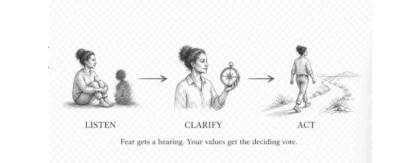
2. Listen to What Your Fear Is Telling You
Ask yourself what the fear is trying to protect.
Is it your safety? Your sense of belonging? Your confidence?
Is there a real danger you need to address, or are you hearing an old story about what you can and cannot do?
Listen with kindness and curiosity.
Fear may have something useful to teach you, but it doesn’t always tell the truth.
3. Clarify What Matters Most
Think about the values you want to guide your response.
Perhaps Love calls you toward an honest conversation.
Maybe Transformation invites you to release an old habit.
Perhaps Interdependence reminds you that you don’t have to manage everything alone.
Let your values help you choose your direction.
4. Act Through One Meaningful Step
Choose something small enough to do and important enough to matter.
Send the email. Make the appointment. Ask for help. Offer an apology. Set the boundary.
And remember, courage doesn’t always mean pushing forward.
Sometimes the courageous choice is to rest, step away, or say no.
What matters is whether your choice reflects your values and supports the life you’re trying to create.
Can You Keep Growing Even When You’re Afraid?
Absolutely.
Becoming the person you want to be isn’t a single event. It’s a practice that continues throughout your life.
You will have moments of confidence and moments of doubt. You will make mistakes, learn, change direction, and begin again.
And you don’t have to do it alone.
We grow through our relationships, our communities, and the wisdom we gain along the way.
Courage isn’t something you either possess or lack. It’s something you practice through your relationship with fear, truth, your values, and other people.
You don’t need certainty to begin.
You need a willingness to listen, choose, and take the next faithful step.
Your Next Step: Choose One Place to Practice Courage
This week, think of one place where fear has been making too many decisions in your life.
Take a few minutes with a journal or a quiet moment of reflection.
Write down four words: Notice. Listen. Clarify. Act.
Name your fear, listen to what it’s telling you, identify the value you want to honor, and choose one small step you can take.
You don’t have to be fearless.
You can move forward with wisdom, with support, and with Love at the center.
And you can keep becoming.
Adapted from “The Courage to Keep Becoming,” a sermon delivered by Rev. Dianne M. Daniels at the Unitarian Universalist Congregation of Norwich on October 4, 2026.
Discover more from Unitarian Universalist Congregation of Norwich
Subscribe to get the latest posts sent to your email.